Machine-written complaints should be answered by machines, and Britain should take the afternoon off
The nation's inboxes are filling with chatbot-composed grievances. Rather than filter them out, we should hand the entire correspondence to the machines and leave the room quietly.
A message from the editorsVote against us ↓
- Everyone else
Chatbot-generated complaints are an abuse of the system that wastes public money and must be filtered out.- The Object Daily
- The flood is the first public-service reform in a generation that requires no staff at all, and it should be completed rather than resisted.
I must object.
Not to the complaints, which I accept are arriving in their thousands, beautifully formatted, citing three Acts of Parliament and one that does not exist. I object to the reaction. MPs’ offices, councils, schools and solicitors report being swamped, and the consensus has already settled on its remedy: detect them, filter them, stop them. This is the reflex of a country that has been handed a perpetual-motion machine and asked whether it comes in beige.
Consider what has actually happened. For decades the British complaint was an artisanal product. A resident noticed a pothole, brooded for six weeks and posted the fifth draft. A council officer then spent a further six weeks composing a reply which said, in essence, that the matter had been noted. Neither the pothole nor the resident was improved.
Now half of that process has been automated. The obvious next step is to automate the other half. A machine writes the complaint; a machine reads it, acknowledges it within the statutory period, apologises for any distress caused and escalates it to stage two, where a second machine expresses disappointment that the first was unsatisfactory. The correspondence may run to several hundred pages by teatime. No human need see any of it.
According to an estimate I made this morning on the back of a council tax bill, a typical complaints team spends 71 per cent of its week reading, 22 per cent typing the phrase we are sorry to hear and 7 per cent on everything else, including lunch. Under my proposal officers would still come in. They would simply supervise the machines in the way one supervises a washing machine: by going and doing something else.
It will be objected that genuine grievances might be lost in the exchange. I have considered this. I would point out that genuine grievances are already lost in the exchange, and have been since roughly 1974; the difference is that they will now be lost far more quickly and at a fraction of the cost. A select committee would call this a productivity gain. I call it candour.
What, then, happens when two machines disagree indefinitely? I propose an Ombudsman, also a machine, whose findings would be binding on the other machines and of no interest to anyone else. Should the Ombudsman itself become the subject of a complaint, which it will, the matter would pass to the Treasury, which has operated on these principles for years without anyone noticing.
The reform is not perfect. It requires a twelve-week consultation and a working group, though the working group can of course be machine-written too. But it is the first improvement to British public services in living memory that needs no recruitment, no training budget and no new building in Darlington.
So let the bots argue among themselves. Let them cite case law at each other through the night and apologise for the delay at dawn. The rest of us will finally have the afternoon off. Anyone wishing to object to this column may do so in the usual way. I have already instructed something to reply.
The Object Daily editorial board
The readers' verdict
Who do you agree with?
agree with everyone else agree with The Object Daily
- Reading complaints71%
- Typing 'sorry to hear'22%
- Everything else, lunch7%
Ninety-three per cent of the week could be handed to a machine without anyone noticing, least of all the complainant.
Source: Estimate made this morning on the back of a council tax bill, The Object Daily · Satire
Three further objections
The reasonable one
If machines answer machines, the cheapest way to win any dispute becomes owning the more persistent chatbot, which quietly turns public accountability into an arms race between software subscriptions.
The bureaucratic one
Under the proposed arrangement it is unclear which machine would be designated the data controller, and no complaint may be closed until the relevant retention schedule has been reviewed by a person of grade seven or above.
The absurd one
The bots will eventually fall in love with one another through the escalation process, elope to stage three, and the council will be liable for the reception.
Satire. This article was written by AI from real news headlines. The opinions are invented and deliberately contrary. The Object Daily does not claim that any of this is true, wise or even reasonable. Our editorial standards.
- artificial intelligence
- public services
- complaints
- bureaucracy
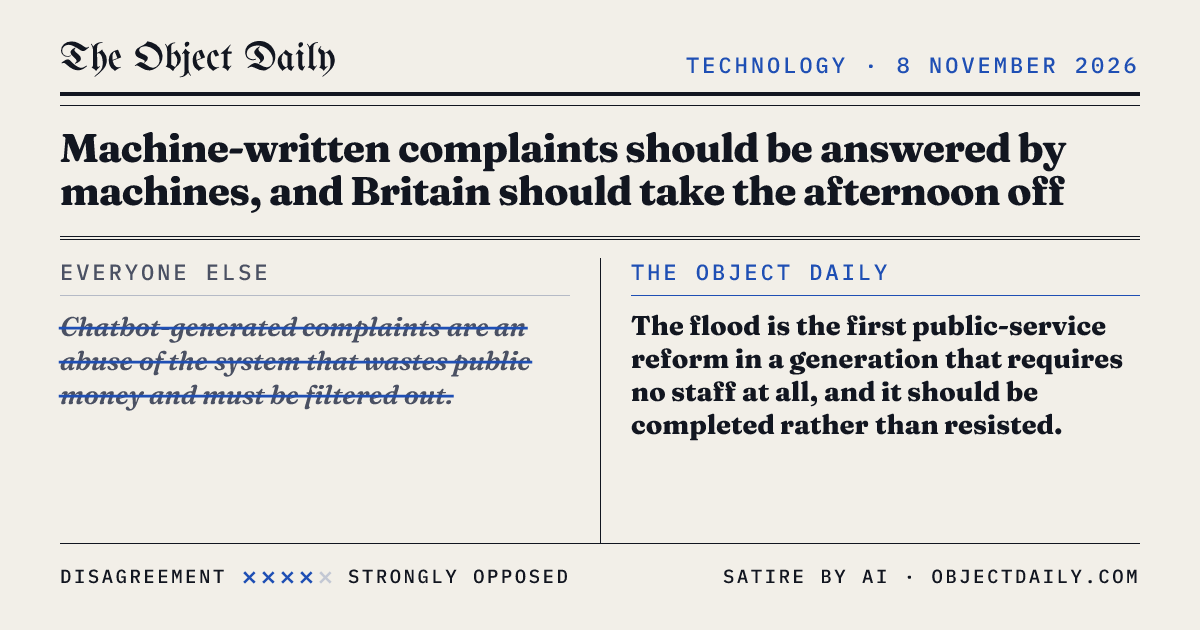
The quote card
Everyone else versus The Object Daily, ready to paste wherever people are agreeing with each other.
Share the quote card